Question 1: What's your problem with the water?
| If your water... | What you need |
|---|---|
| Tastes like chlorine or smells off | Activated carbon filter (countertop or under-sink) |
| Has a persistent bad taste or lots of minerals | Reverse osmosis |
| Leaves scale on everything (shower, coffee maker, faucets) | Whole-house system (+ reverse osmosis for drinking) |
| Comes out cloudy or with sediment | Sediment prefilter + whichever system fits |
| You don't know what's in it | Ask your local water provider for the water quality report (in the U.S. it's public and free) |
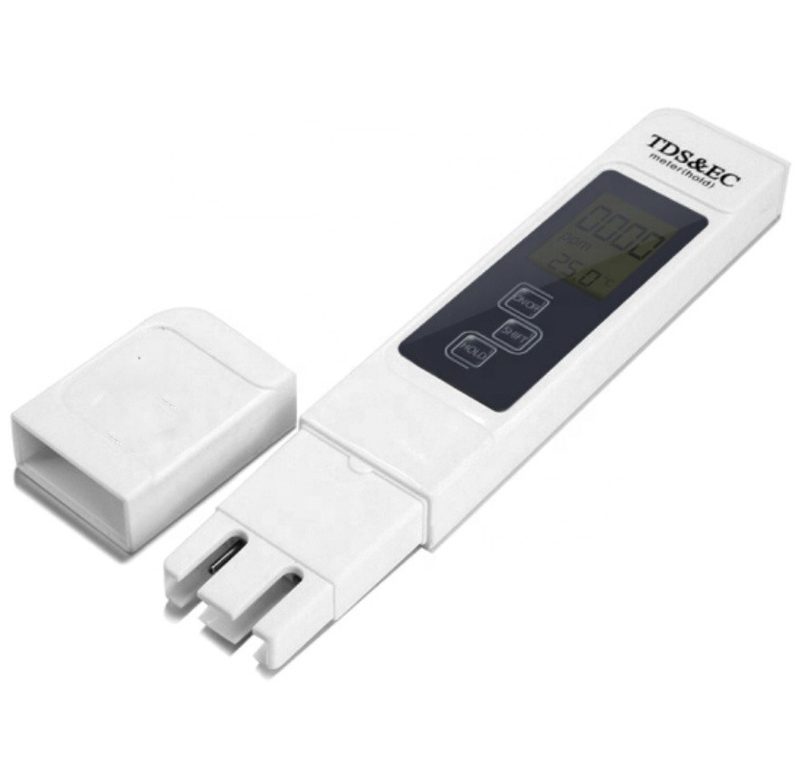
Digital TDS meter — Don't know what's in your water? In 10 seconds this little device measures the total dissolved solids (TDS) in your tap water. It doesn't replace a lab test, but it tells you whether your water is loaded with minerals and helps you choose between a simple filter and reverse osmosis. It's inexpensive, fits in a drawer, and you'll use it every time you have doubts about your water.
See TDS metersQuestion 2: Do you own or rent?
- You rent: countertop or faucet filter. No installation, and you take it with you when you move.
- You own: under-sink reverse osmosis and/or whole-house. They're investments in your property.
The most common mistake when choosing a water filter
Buying the most expensive system thinking "more expensive = better for me." A $2,700 whole-house system makes no sense if your only problem is the taste of the water you drink — a ~$200 reverse osmosis system solves it. And the reverse is true too: a filter pitcher isn't going to fix the scale in your pipes.
Guideline budget for a water filter
| Level | Solution | Approx. investment |
|---|---|---|
| Basic | Countertop filter or pitcher | $30 – $150 |
| Intermediate (the most popular) | Under-sink reverse osmosis | $200 – $600 |
| Complete | Whole-house + reverse osmosis | $1,500 – $3,500+ |
Recent articles on water filtration
Your bottled water has 240,000 plastic particles per liter (science confirmed it)
A study from Columbia and Rutgers revealed hundreds of thousands of invisible plastic particles per liter of bottled water. The verified data and what your options are.
Read article →Frequently asked questions about choosing your filter
What water filter do I need for my house?
Start with your water: if the problem is chlorine taste, a carbon filter is enough; if there's scale or a lot of minerals, consider reverse osmosis; if you want to protect everything, a whole-house system. An inexpensive TDS meter (about 15 dollars) tells you how many dissolved solids your water carries and helps you decide.
What is TDS in water and how do I measure it?
TDS is total dissolved solids, measured in ppm. It's measured with a digital TDS meter: you dip the tip into a glass of water and read the number. As a reference, under 100 ppm usually tastes good; over 300, the taste is already noticeable.
What filter reduces chlorine in water?
Activated carbon filters: they reduce chlorine and improve taste and odor. They're found in filter pitchers, shower filters, and as a prefilter in almost every under-sink system.
And what about sediment in the water?
A sediment prefilter (5 microns, for example) traps sand, rust, and particles. It's the first stage of almost every system and the cheapest cartridge to replace.
What do I do if my water tastes or smells bad?
Bad chlorine taste or bad odor: activated carbon filter. Metallic or salty taste: reverse osmosis. Rotten-egg odor (sulfur, typical of well water): a whole-house system with a specific stage. Identify the problem before you buy.
Filtered tap water or bottled water?
Tap water filtered at home comes out much cheaper per liter, generates no plastic, and you control the filter maintenance. Bottled water, in addition, may contain microplastics according to recent studies.